
Proactive Detection & Response in OT
Catch adversaries at the reconnaissance phase — the earliest point in the OT kill chain — with zero risk to production.
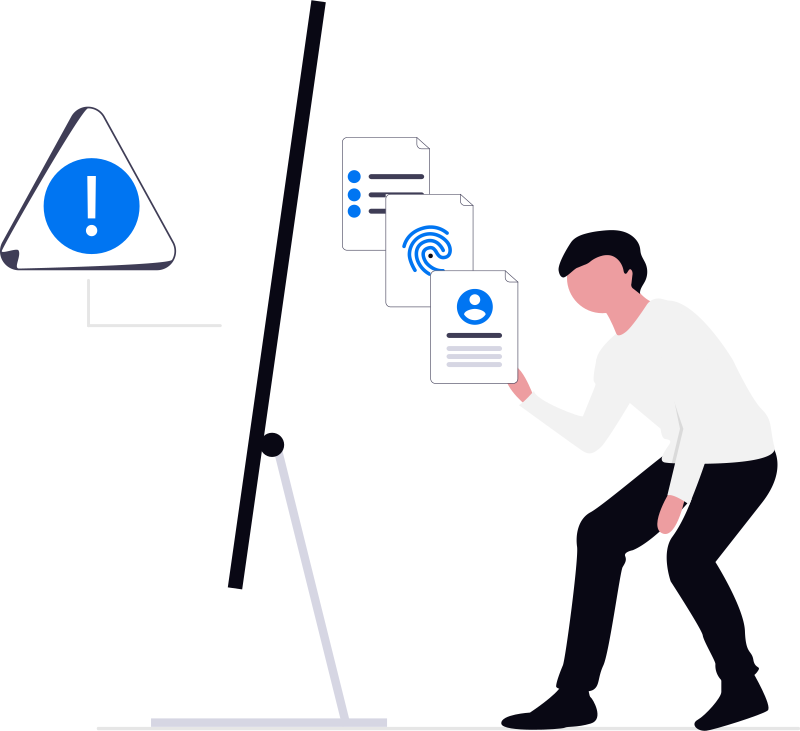

OT attacks begin with reconnaissance — probing protocols, enumerating devices, and mapping the control network. Today that phase is invisible: there are no alerts until a process fails.
IT security tools can't be used safely in OT. Scanning PLCs or deploying agents on HMIs can disrupt live processes, void warranties, or violate policy — so defenders watch passively, or not at all.
AMazeTM places protocol-accurate Synthetic Cognitive Agents inside OT that never scan, probe, or touch production. No legitimate process talks to one, so every interaction is adversarial by construction — with zero false positives.
How AMazeTM Detects OT Threats
AMazeTM ships protocol-accurate Synthetic Cognitive Agents for operational environments — passive, persistent, and never inline. Every event is enriched with a MITRE ATT&CK for ICS technique, threat score, and attribution, in one dashboard alongside IT and identity.
Out-of-the-Box Protocols
Ships protocol-accurate SCAs for Modbus TCP, EtherNet/IP, S7comm, DNP3, and BACnet. IEC 60870-5-104, OPC UA, and vendor protocols are added as BYOT device personas.
Build Your Own Trap (BYOT)
BYOT stands up a protocol-accurate SCA for any device from a single JSON file — live in minutes, never scanning or touching production.
Zero False Positives
No legitimate process talks to an SCA, so every interaction is adversarial by construction — capturing source, protocol, technique, and command sequence in full.
ICS-Tagged Intelligence
Every event is enriched with a MITRE ATT&CK for ICS ID, threat score, and attribution, correlated onto one dashboard alongside IT and identity events.
See AMazeTM in action
Common questions
- What is OT security?
- OT security protects the industrial control systems that run physical processes — PLCs, SCADA servers, historians, and the engineering workstations that reach them. It differs from IT security because the systems often cannot be patched on demand, cannot run endpoint agents, and cannot be taken offline to test a defense.
- How is AMazeTM different from OT network monitoring?
- Passive monitoring infers intent from traffic patterns, which produces alerts that still need an analyst to confirm. AMazeTM deploys Synthetic Cognitive Agents that speak real industrial protocols alongside your equipment. No legitimate process has a reason to talk to them, so any interaction is a confirmed adversary rather than a probability score.
- Does deploying this put production at risk?
- No. Synthetic Cognitive Agents run beside production rather than inline, so they never sit in the path of a control loop and cannot delay or block a real command. Nothing is installed on the PLCs or HMIs themselves.
- Where in the OT kill chain does this detect an attacker?
- At reconnaissance — the earliest stage. Adversaries in an OT network must first discover what equipment exists and how it is addressed. That discovery step is what interacts with a synthetic asset, which is why detection lands before any manipulation of a physical process begins.
- Does it work in air-gapped or segmented networks?
- Yes. Deployment does not depend on outbound internet access, and signals can be kept entirely inside the environment or forwarded to an existing SIEM across whatever boundary your architecture allows.
More on OT security
Guides and analysis from the MirrorMire team.
Detect OT Threats at the Earliest Point
See how protocol-accurate detection turns OT blind spots into high-confidence intelligence — without touching production or changing operational policy.
Request a Demo