
MirrorMire Blog: Cyber Deception and Threat Intelligence
Subjects

Why Attackers Hate Deception
Discover how AI-native deception helps expose adversary behavior, turn deceptive interactions into actionable intelligence, and strengthen proactive cyber resilience.
Read article
Can AI Detect Attackers Before They Strike?
Can AI spot attackers before they strike? Explore how AI analyzes behavioral patterns and threat signals to detect suspicious activity early and...
Read article
Proactive Cyber Resilience Starts Before the Breach
Reactive tools miss the early moves an attacker makes. Proactive cyber resilience, defined, with the numbers behind it and where to start.
Read article
The Hidden Window Between Intrusion and Impact
Adversaries don’t go from intrusion to impact in a single move. They map, maneuver, and adapt. The hidden window between those moments...
Read article
Prompt Injection Is Not a Bug You Can Patch
Why securing AI agents is a permanent requirement rather than a transitional one. The flaw at the centre of it is not...
Read article
The Breach Doesn't Start on the Day You Discover It
We often mark a breach from the day it's detected. In reality, that's when defenders finally notice. The real question isn't when...
Read article
The Attacker Only Has to Be Right Once. We Think That Rule Should Break.
A trip-wire answers one question: did you touch it? A reflection asks a harder one: can you tell you're not in the...
Read article
The Future of Cybersecurity Is Proactive, Not Reactive
Stop chasing alerts after the breach. Explore how proactive AI-driven detection with Neural Echoes and Synthetic Cognitive Agents uncovers threats before they...
Read article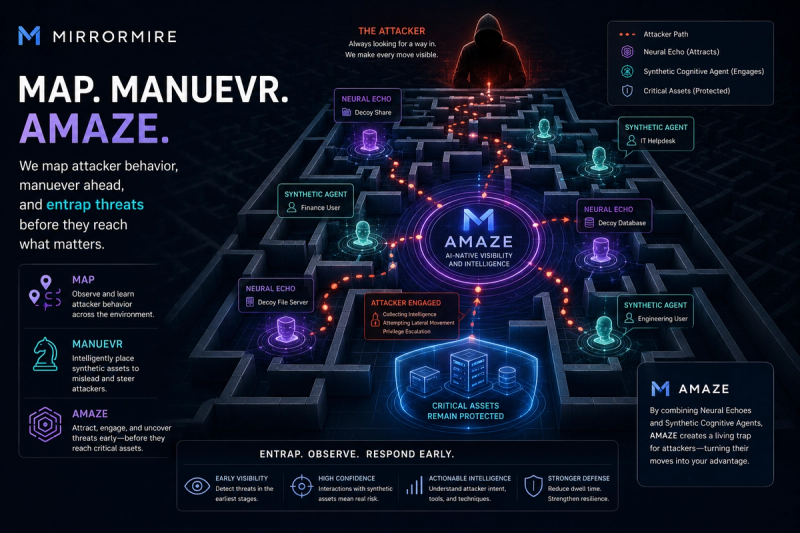
Beyond Reactive Security: Using Neural Echoes and Synthetic Cognitive Agents for Early Threat Detection
Move beyond reactive security. Explore how Neural Echoes and Synthetic Cognitive Agents enable proactive threat detection, reduce alert fatigue, and strengthen cyber...
Read article
How Cyberattacks Shut Down Factories Without Touching a Single Machine
Jaguar Land Rover lost roughly five weeks of production and an estimated £1.9 billion, and the attackers never touched a machine on...
Read article
The CISO Response to Mythos: Build a Deception Capability
A new industry briefing warns that AI is compressing the path from vulnerability discovery to exploitation and identifies deception as an important...
Read article
What Are Decoys, Lures, and Synthetic Assets?
Decoys, lures, and synthetic assets are designed to attract attackers away from real systems, helping security teams detect threats early and reduce...
Read article
How Deception Technology Reduces False Positives
Deception technology reduces false positives by using fake assets that legitimate users ignore but attacker's target. This makes alerts far more accurate,...
Read article
Honeypots vs Modern Cyber Deception: Why Decoys Are Evolving
Honeypots were the first generation of cyber decoys. Modern deception goes further, using realistic synthetic assets to engage attackers, reveal intent, and...
Read article
The Dangers of Lateral Movement
A huge challenge in cybersecurity occurs when an adversary already breaches a system and proceeds to move laterally, finding high-value systems causing...
Read article
The Role of Deception in Modern Cyber Defense
Modern defense cannot rely on visibility alone. Deception gives security teams a way to shape attacker behavior, generate 100% certain signals, and...
Read article