Can AI Detect Attackers Before They Strike?
Can AI spot attackers before they strike? Explore how AI analyzes behavioral patterns and threat signals to detect suspicious activity early and help security teams prevent attacks before they escalate.
The Future of Predictive Cyber Defense:
Cyberattacks are evolving from slow, manual operations into highly automated campaigns that can move at machine speed. Attackers are using AI to automate reconnaissance, discover vulnerabilities, scale phishing, and accelerate their movement across compromised environments.
That leaves defenders with a shrinking window to respond.
The critical question is no longer simply, “Can we stop an attack?”
It is:
“Can we recognize the signals of an attack early enough to change its outcome?”
Increasingly, the answer is yes.
Artificial intelligence is helping cybersecurity teams move from a primarily reactive model toward a more proactive and predictive approach. AI cannot predict every attack with certainty, but it can analyze enormous volumes of data, recognize patterns, identify suspicious behavior, and connect seemingly unrelated signals that may indicate an attack is developing.
The goal isn't to predict the future perfectly. It's to see enough of it early enough to act.
Why Predictive Cybersecurity Matters More Than Ever
Cyber threats aren't simply increasing — they're accelerating.
Radware's H1 2026 Global Threat Analysis Report reported a 110.6% increase in Web DDoS attacks compared with H1 2025, highlighting the rapidly changing threat landscape.
At the same time, AI is changing the economics and speed of cyberattacks. Tasks that once required significant human effort — including reconnaissance, vulnerability discovery, and campaign development — can increasingly be automated.
The result is a fundamental challenge for traditional security operations.
When attacks move faster than analysts can investigate thousands of individual alerts, simply detecting an incident after it occurs is no longer enough.
Organizations need to understand:
- What is happening?
- What is unusual?
- Which signals are connected?
- Is an attacker already moving through the environment?
- What could happen next?
- What can we do now to disrupt the attack?
This is where predictive and behavioral AI becomes increasingly valuable.
How AI Helps Detect Attacks Earlier
1. Behavioral Detection and Attack Signal Intelligence
Traditional security tools often rely heavily on known signatures, indicators, or predefined rules. These approaches remain important, but sophisticated attackers can use legitimate credentials, familiar tools, and normal-looking activity to avoid detection.
AI introduces another layer: behavioral analysis.
Instead of asking only whether an event matches a known threat, AI can analyze how users, devices, identities, applications, and systems behave over time.
For example, a single login might appear completely normal.
But when that login is followed by:
- unusual privilege escalation,
- access to systems the user rarely touches,
- lateral movement,
- abnormal data access, or
- suspicious communication patterns,
the combined behavior may reveal an attack in progress.
Vectra AI, for example, uses behavioral AI across network, identity, and cloud environments to identify behaviors such as credential misuse, privilege escalation, lateral movement, and data exfiltration.
The important shift is from isolated alerts to connected attack signals.
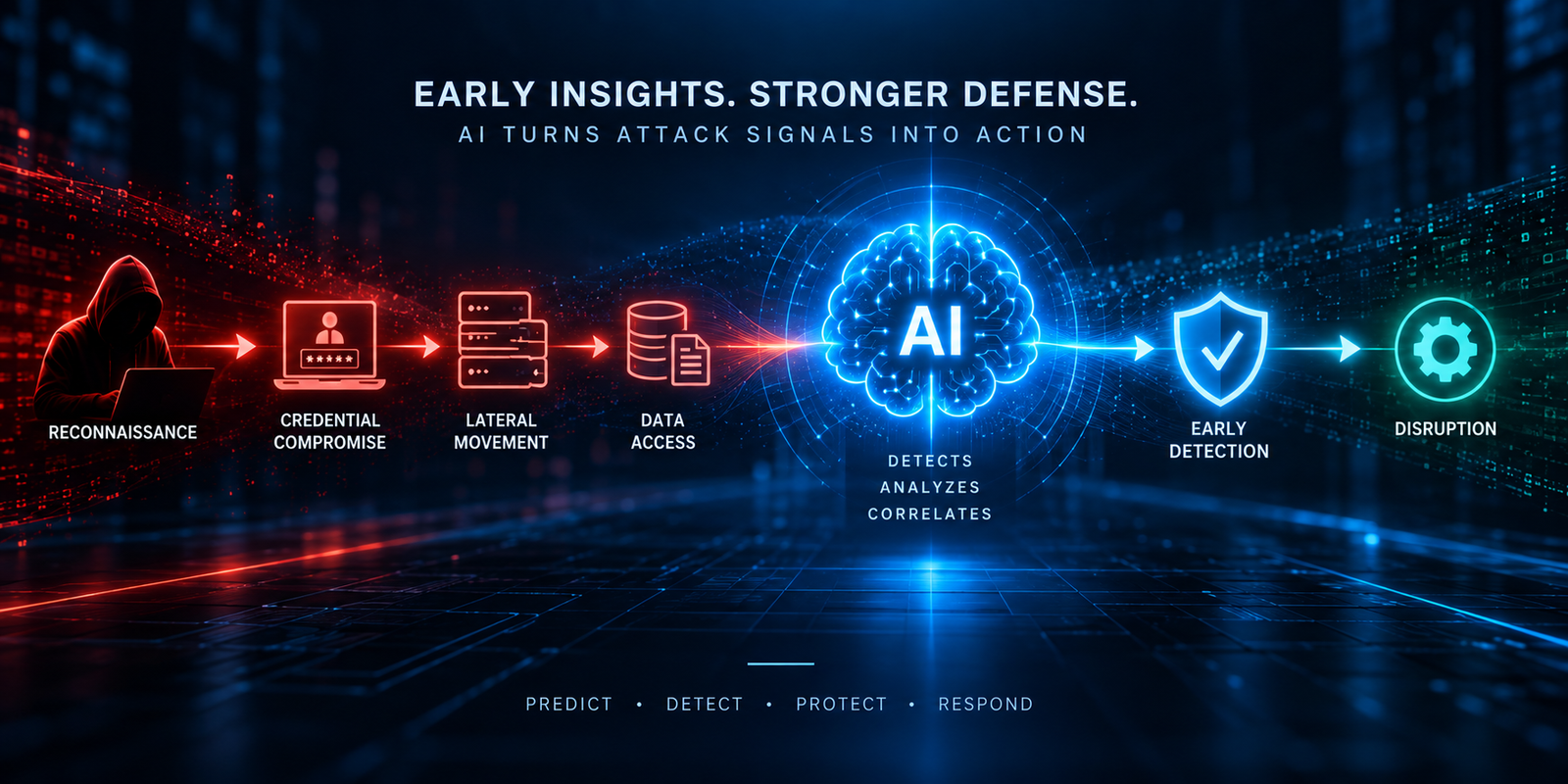
2. Identifying Attack Precursors
Many attacks don't begin with the final malicious action.
They develop through a sequence of smaller steps.
An attacker may first:
- Discover exposed systems.
- Obtain or compromise credentials.
- Test access.
- Escalate privileges.
- Explore the environment.
- Move laterally.
- Locate valuable data.
- Prepare for exfiltration or disruption.
Individually, some of these activities may not look particularly dangerous.
Together, however, they can reveal the progression of an attack.
Machine learning can help identify these patterns by continuously analyzing activity and comparing it with behavioral baselines and known attack techniques.
This doesn't mean AI knows exactly what an attacker will do next.
It means AI can recognize when the current sequence of actions increasingly resembles an attack — giving security teams an opportunity to intervene before the situation becomes more damaging.
3. Connecting Signals Across the Attack Surface
One of the biggest challenges facing modern security teams is fragmentation.
Organizations operate across:
- On-premises infrastructure
- Cloud platforms
- SaaS applications
- Networks
- Human identities
- Service accounts
- AI systems
- IoT and operational technology
An attacker doesn't necessarily respect those boundaries.
They may compromise an identity, move into a cloud environment, access another system, escalate privileges, and eventually reach sensitive data.
If each activity generates a separate alert in a different security tool, analysts may have to manually reconstruct the attack.
AI can help connect those signals.
Vectra AI describes this approach as correlating activity across network, identity, and cloud environments to build a more complete picture of attacker behavior.
That context can be the difference between hundreds of suspicious events and one identifiable attack story.
4. Predictive Threat Intelligence
Predictive cybersecurity also depends on understanding what is happening outside the organization's immediate environment.
AI can analyze large volumes of:
- Threat intelligence
- Vulnerability information
- Network telemetry
- Authentication activity
- Historical incidents
- Security research
- User and entity behavior
The objective is to identify patterns that could indicate increasing risk.
For example, if a newly disclosed vulnerability affects an organization's technology stack, AI-driven security systems can help prioritize which assets are exposed, which identities have access to them, and whether suspicious activity is already occurring around those systems.
This moves threat intelligence from simply informing security teams to helping them prioritize what needs attention first.
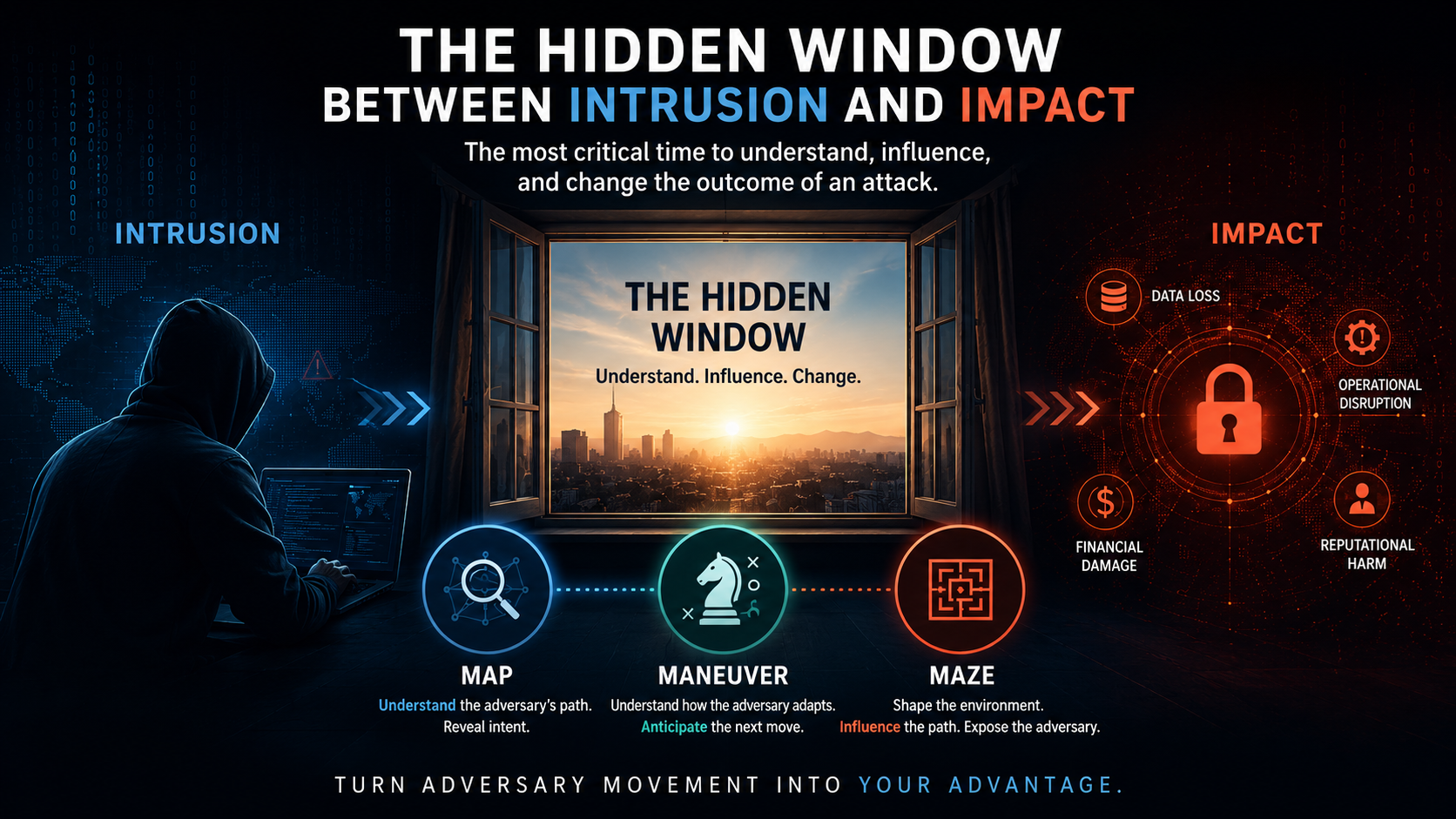
5. From Detection to Preemptive Defense
Predictive defense doesn't end with identifying a suspicious signal.
The real value comes from what happens next.
A mature AI-driven security strategy can help organizations:
Deny - prevent attackers from gaining or expanding access.
Deceive - use decoys and controlled environments to make attacker activity easier to identify.
Disrupt -interrupt attack progression before it reaches critical systems or sensitive data.
This represents a broader shift in cybersecurity:
From detecting what happened to understanding what is happening - and deciding what should happen next.
Real-World Examples of AI-Driven Early Detection
AI Models Built to Detect Intrusions Early
Predictive cybersecurity isn't limited to commercial security platforms.
FICO's 2026 Educational Analytics Challenge is asking students to build machine-learning systems capable of identifying network intrusions before they cause damage. The program includes scenarios involving denial-of-service attacks, botnets, ransomware, and cryptomining.
The initiative illustrates an important point: using machine learning to identify intrusion patterns is becoming an increasingly practical cybersecurity discipline — not simply a theoretical research concept.
AI Security Moves Into Federal Environments
Another indicator of the growing role of AI in cybersecurity is its adoption in high-security environments.
In August 2026, Vectra AI announced that it had achieved FedRAMP High Authorization through its partnership with Knox Systems. The authorization enables U.S. federal agencies to deploy Vectra's AI-native security capabilities in environments handling highly sensitive, non-classified government data.
The significance goes beyond compliance.
It demonstrates how AI-driven security is increasingly being used to correlate attack signals, prioritize real attacker activity, and help defenders act earlier across complex environments.
The Benefits of Predictive AI Defense
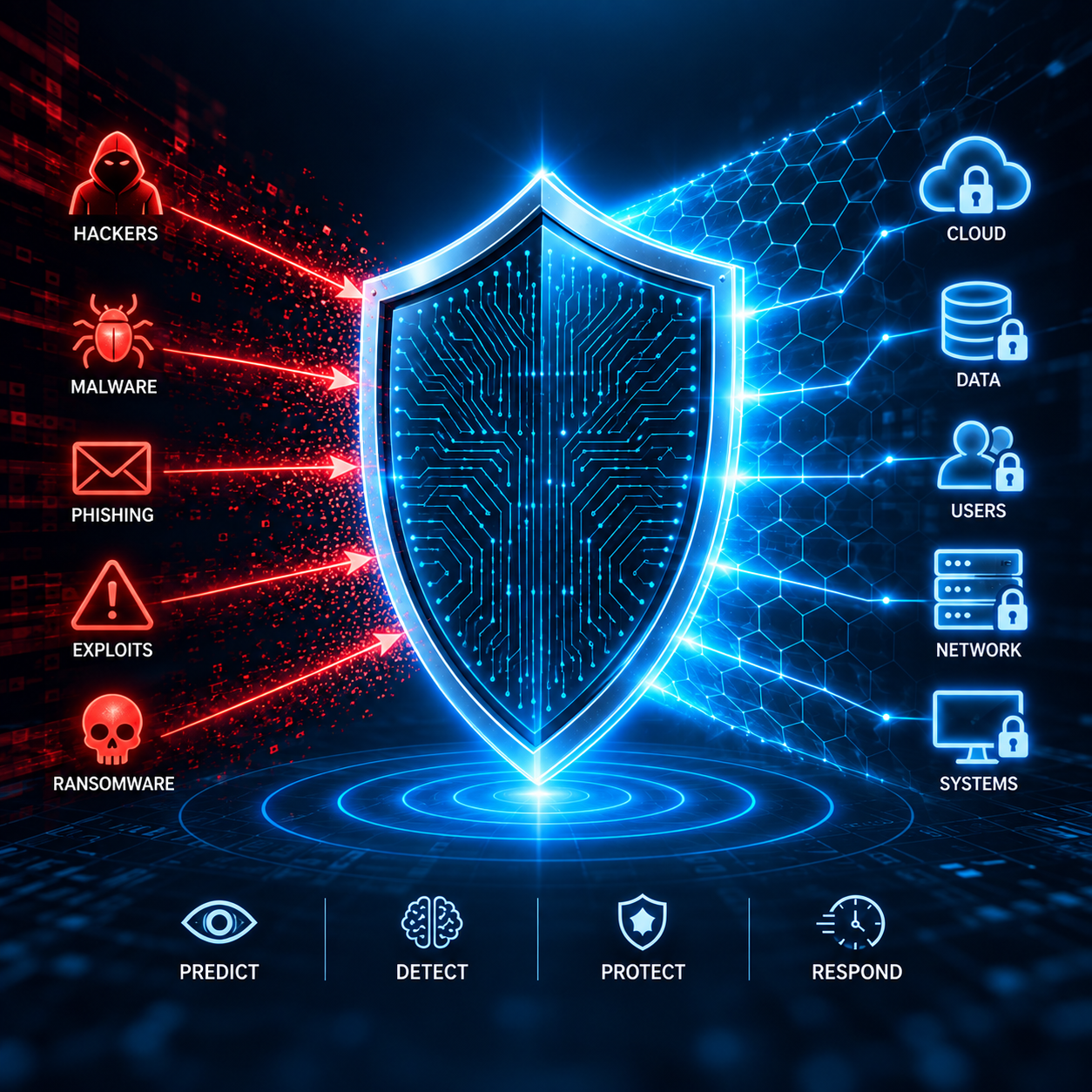
When implemented effectively, predictive and behavioral AI can help organizations:
Detect earlier
Identify suspicious behavior and attack progression before significant damage occurs.
Prioritize what matters
Separate high-risk attack signals from the enormous volume of routine security events.
Reduce investigation time
Correlate activity across identities, devices, networks, cloud environments, and applications.
Reduce the attack surface
Identify exposed assets, risky identities, excessive permissions, and potential attack paths before they are exploited.
Respond faster
Automate investigation and, where appropriate, containment and response actions.
Protect complex environments
Extend visibility across cloud, SaaS, legacy infrastructure, identities, and other environments where traditional endpoint-based approaches may not provide complete coverage.
The Challenges: AI Is Not a Crystal Ball
Predictive cybersecurity comes with important limitations.
AI systems depend on the quality and context of the data they analyze. Poor data can lead to poor conclusions.
There is also a fundamental arms race: attackers are using AI too.
Threat actors can use AI to automate reconnaissance, generate convincing phishing campaigns, adapt malware, and search for vulnerabilities faster.
Security teams therefore cannot treat AI as a one-time technology deployment.
Models need continuous improvement, security teams need meaningful context, and organizations need processes for validating AI-generated signals and decisions.
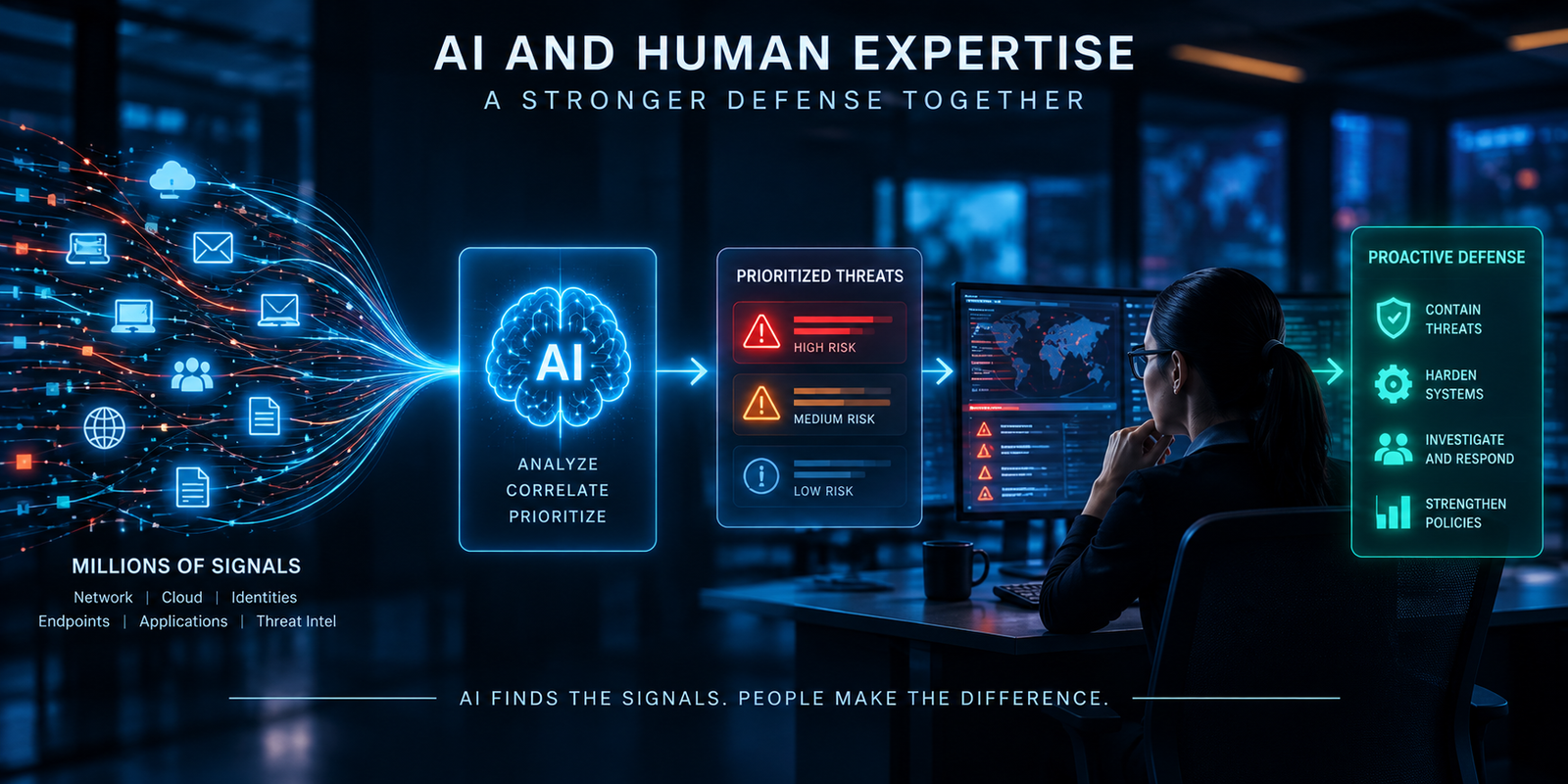
Most importantly, AI should augment human expertise rather than replace it.
The strongest approach combines machine-scale analysis with human judgment.
So, Can AI Detect Attackers Before They Strike?
Sometimes - but the more accurate answer is that AI can detect the signals that precede an attack.
It can identify abnormal behavior, recognize attacker techniques, connect activity across environments, uncover risky attack paths, and help security teams understand how an attack is progressing.
That distinction matters.
Cybersecurity isn't about building a system that can predict every attack with perfect accuracy.
It's about creating enough visibility and intelligence to move the decision point earlier.
Instead of waiting for ransomware to encrypt systems, organizations want to identify the suspicious activity that came before it.
Instead of waiting for data exfiltration, they want to detect unusual access and staging behavior.
Instead of discovering a compromised identity after the attacker has moved laterally, they want to recognize the abnormal behavior that signals the account may no longer be trustworthy.
That is the real promise of predictive cyber defense.
The Future of Cyber Defense
The future of cybersecurity will not be defined simply by how quickly organizations respond to attacks.
It will be defined by how early they can recognize the signals that precede them.
AI gives security teams the ability to analyze more data, connect more signals, understand attacker behavior, and identify risk at a scale that would be difficult for humans alone.
At MirrorMire, we believe this is where cybersecurity is heading: from reactive detection toward proactive intelligence and predictive defense.