
Proactive Cyber Resilience Starts Before the Breach
Reactive tools miss the early moves an attacker makes. Proactive cyber resilience, defined, with the numbers behind it and where to start.
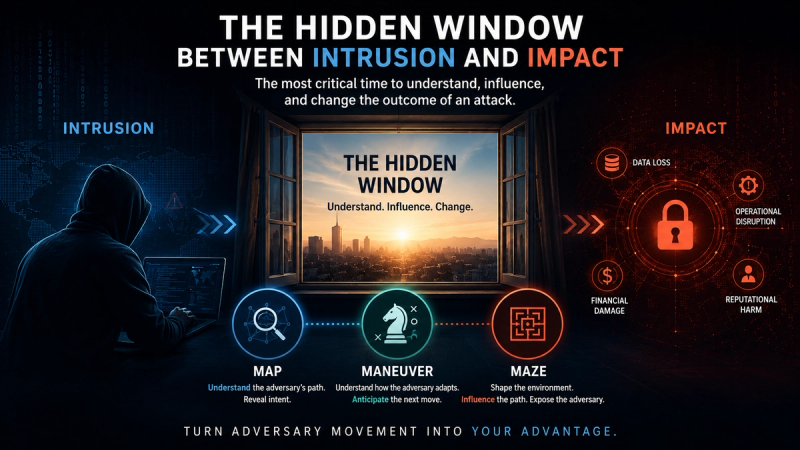
Proactive cyber resilience is the practice of finding and understanding an adversary while they are still deciding what to do, and acting before that decision becomes damage. It is an operating model rather than a product category: see more, validate faster, and reduce uncertainty before an attacker gains meaningful ground.
Most organizations still think about cyber resilience as the ability to recover after an attack. Recovery matters, but it is no longer enough. In a threat landscape shaped by automation, AI-assisted attacks and increasingly complex environments, resilience has to begin before a breach turns into disruption. We have argued elsewhere that the old rule, the attacker only has to be right once, should break. This post is about the operating model that breaks it, and about why the tools most organizations rely on cannot.
In short
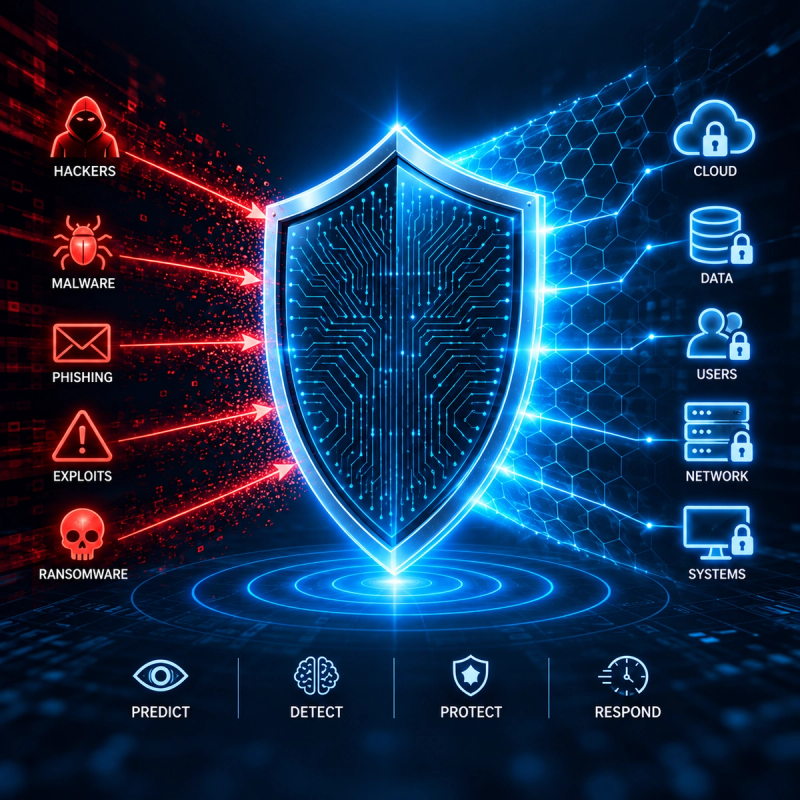
Reactive security waits for a known indicator, a written rule, a deviation from a baseline, or a declared incident. All of those arrive after the adversary has done the early work: reconnaissance, credential collection, the first lateral move. Proactive cyber resilience moves the defender's first move to the moment an adversary reveals intent by touching something they should not. That shift changes what the SOC does all day, and it changes the cost of a breach.
Recovery is not resilience
The cost of poor visibility keeps rising. IBM's 2025 Cost of a Data Breach report found that the global average cost of a data breach was USD 4.44 million, and that the average breach lifecycle, from first occurrence to containment, was 241 days. The same research found that 63% of organizations studied lacked AI governance policies, and that 97% of organizations that experienced an AI-related security incident did not have proper AI access controls in place.
Those numbers point to a larger problem. Many organizations are expanding their digital footprint faster than they are improving their ability to govern and defend it. Resilience has to move upstream. Instead of waiting for alerts to pile up and hoping analysts can sort signal from noise, teams need to understand attacker behavior earlier in the cycle. They need visibility into intent, not just activity.
What reactive security is built to see
Traditional security tools are designed to react after something suspicious or malicious has been detected. The problem is what "detected" means in practice. Almost all reactive tooling is built around four things:
- Known malware signatures and indicators that have been seen somewhere else.
- Rule-based detections, written in advance for behavior someone anticipated.
- Abnormal events measured against a baseline, after the activity has happened.
- Alerts tied to production assets, where legitimate activity never stops.
Attackers today move carefully, and much of what they do in the first days looks like ordinary administration. They perform reconnaissance. They identify privileged accounts. They test lateral movement paths. They probe cloud, IT and OT environments. They blend into normal user behavior, often with a valid credential. Because these activities resemble legitimate actions, they do not immediately trigger a SIEM, an EDR or a firewall.
By the time reactive controls respond, the adversary has usually already established persistence, escalated privileges, mapped the critical systems and reached sensitive data. The alert is real. It is also late, and late is the whole problem.
| Reactive control | What it waits for | The proactive counterpart |
|---|---|---|
| Signature-based detection | A hash, domain or address already seen somewhere else | The behavior of a confirmed adversary, whether or not it has been seen before |
| Rule-based alerting | A rule someone wrote for a move they anticipated | An interaction with something no legitimate user has a reason to touch |
| Anomaly scoring | A measurable deviation from a baseline of normal | Certainty from context: the source had no business being there at all |
| Incident response | A declared incident | Intelligence gathered during the early phase, before anything is declared |
| Recovery planning | The outage, the encryption, the exfiltration | Shaping where the adversary goes so the objective is never reached |
What proactive is not
Proactive cyber resilience is not a product category, and it is not prevention with a better name. Prevention tries to keep the adversary out and fails the moment a credential is phished. Monitoring watches everything and asks an analyst to decide afterwards what mattered. Proactive resilience assumes the adversary will get in, and arranges the environment so that getting in is the moment they are found.
Three tests separate it from a rebranding of the old model. First, the signal has to be certain rather than scored: an interaction with something that has no legitimate audience, not a deviation from normal. Second, the intelligence has to arrive during the early phase, while the adversary is still deciding, not in the post-incident report. Third, the response has to be able to shape where the adversary goes next, not only stop the current move. A control that fails any of the three is reactive, whatever it is called.
What changes when intent is visible
The practical form of the proactive model is to put things in the environment that no legitimate user or service has any reason to touch, and to treat any touch as confirmed. Synthetic Cognitive Agents mirror real systems and speak real protocols, so an adversary doing reconnaissance treats them as production. Neural Echoes are credentials and artifacts seeded where adversaries look during discovery, each chained back to a mirrored system so that using one produces a login that could only have come from an adversary.
Legitimate users ignore them, because they have no reason to know they exist. Adversaries interact with them naturally, because reconnaissance and lateral movement are exactly the activities that find them. That means security teams see the adversary during the early phase, often before ransomware execution, data exfiltration or operational disruption, with the command, the protocol, the source and the technique recorded rather than inferred.
In simple terms: reactive security responds after danger becomes visible, while proactive detection exposes attackers while they are still searching for a path in.
What proactive changes for the business
A proactive model improves decision-making. When a team can verify whether an alert is real, observe how an attacker behaves, or see which assets are actually being targeted, response becomes faster and more precise. That matters operationally, and it matters financially. IBM's 2025 report found that organizations making extensive use of AI in security saved an average of USD 1.9 million per breach compared with those that did not, and shortened the breach lifecycle by 80 days.
Better intelligence and better automation do not only improve security outcomes. They improve business resilience: less downtime, smaller disclosures, faster recovery and more trust retained when the pressure is highest. Cyber resilience should not begin at the point of impact. It should begin at the first sign of intent.
Where to start on Monday
- Pick the three questions your SOC cannot answer today without an investigation: is this alert real, what is this adversary after, and which asset is actually being targeted. Those are the questions a proactive model answers first.
- Write down where an adversary would look in their first 48 hours inside your network: credential stores, file shares, admin consoles, the domain controller. Put something in each of those places that has no legitimate audience and reports when it is touched.
- Route confirmed interactions above anomaly scores in the queue, and measure the time from event to a human.
- Track two numbers each quarter: how early the first adversary interaction is caught, and how many analyst hours each confirmed event costs. Both should fall.
At MirrorMire we believe the future of cyber defense belongs to organizations that do more than react. The next generation of resilience will come from understanding adversaries earlier, engaging them intelligently, and building defenses that are designed to move before damage does.