The Hidden Window Between Intrusion and Impact
Adversaries don’t go from intrusion to impact in a single move. They map, maneuver, and adapt. The hidden window between those moments is where proactive cyber resilience can change the game.
An intrusion is not the same as impact.
The most valuable defensive opportunity exists in the space between them.
Once an adversary gains access to an environment, the attack doesn't immediately become a headline. There is often a period of reconnaissance, discovery, experimentation, and movement.
They are learning.
They are mapping.
They are testing.
They are deciding what to do next.
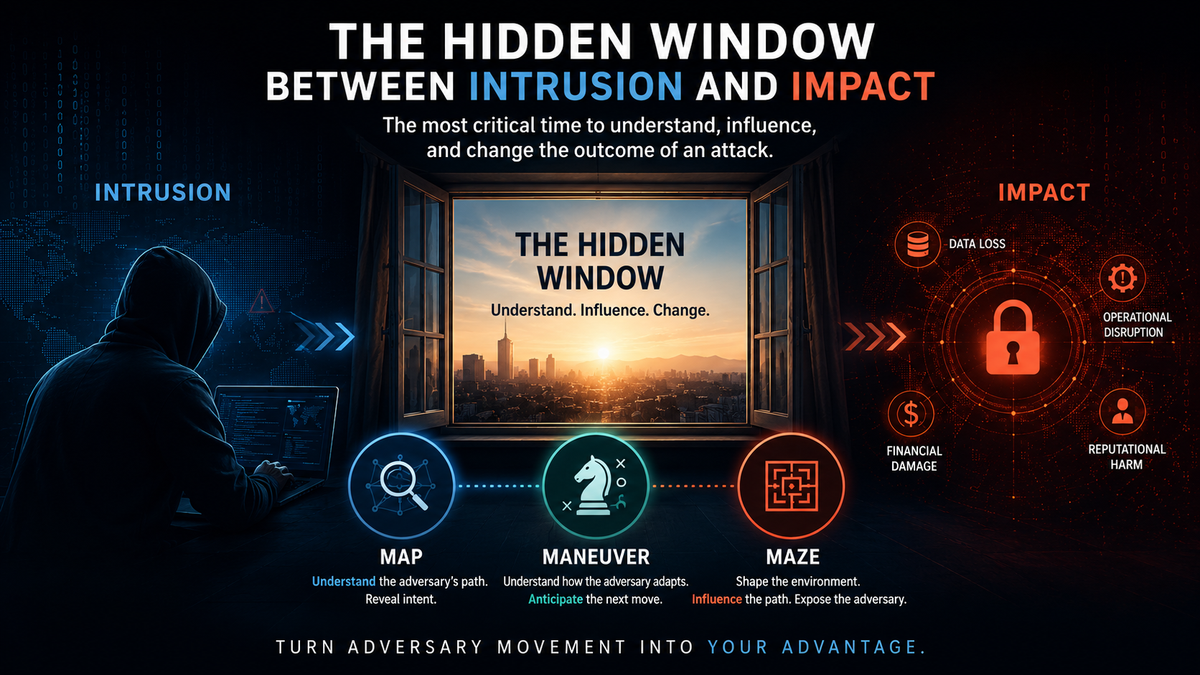
This is the hidden window between intrusion and impact - and it may be one of the most valuable opportunities defenders have to change the outcome of an attack.
The Hidden Window
Initial access is only the beginning.
An adversary may search for credentials, identify privileged accounts, discover critical systems, map relationships, move laterally, establish persistence, and test the organization's defenses.
Every decision they make can reveal something about their intent.
The question is no longer simply:
“Can we detect the adversary?”
It becomes:
“Can we understand where they are going - and influence where they go next?”
That requires a different approach.
Map. Maneuver. Maze.
At MirrorMire, we see the hidden window through three connected ideas:
MAP
Understand the adversary's path.
Adversaries map their surroundings before making their next move.
They look for identities, systems, privileges, applications, relationships, and potential targets.
That activity creates intelligence.
The goal is to understand not only where the adversary is, but what they are trying to discover and what that discovery tells us about their objectives.
Map the behavior. Reveal the intent.
MANEUVER
Understand how the adversary adapts.
Adversaries rarely follow a perfectly predictable path.
They test assumptions. They change direction. They escalate privileges. They respond to what they encounter.
Their maneuvering is itself a signal.
A proactive defense should be able to observe these decisions and adapt accordingly - turning adversary movement into an opportunity to learn more about their behavior.
Understand the move. Anticipate the next one.
MAZE
Change the environment to change the game.
What if the environment didn't simply wait for an adversary to move through it?
What if it could create believable paths, interactions, identities, and systems that encourage the adversary to reveal more about themselves?
A maze is not simply a trap.
It is an environment designed to introduce uncertainty, slow progress, expose behavior, and create time for defenders to understand and respond.
The objective is not just to stop movement.
It is to shape the journey.
Create the maze. Influence the path. Expose the adversary.
From Detection to Deception
Traditional security often follows a familiar sequence:
Prevent → Detect → Respond
But the hidden window creates an opportunity for something more proactive:
Map → Maneuver → Maze
Instead of waiting for an adversary to reach a critical asset, organizations can use deception and adaptive environments to understand their behavior while they are still navigating the environment.
This is where AI can fundamentally change the equation.
AI-native security can help create environments that are more dynamic, responsive, and capable of adapting to adversary behavior—rather than relying solely on static decoys or predefined rules.
Turning Time into an Advantage
The objective is not simply to know that an adversary is inside.
The objective is to understand what they are trying to accomplish before they accomplish it.
Every interaction can provide intelligence.
Every maneuver can reveal intent.
Every unexpected path can expose an assumption.
And every moment before impact creates another opportunity to respond.
That is the promise of proactive cyber resilience.
The future of cybersecurity will not be defined solely by how quickly organizations detect an attack.
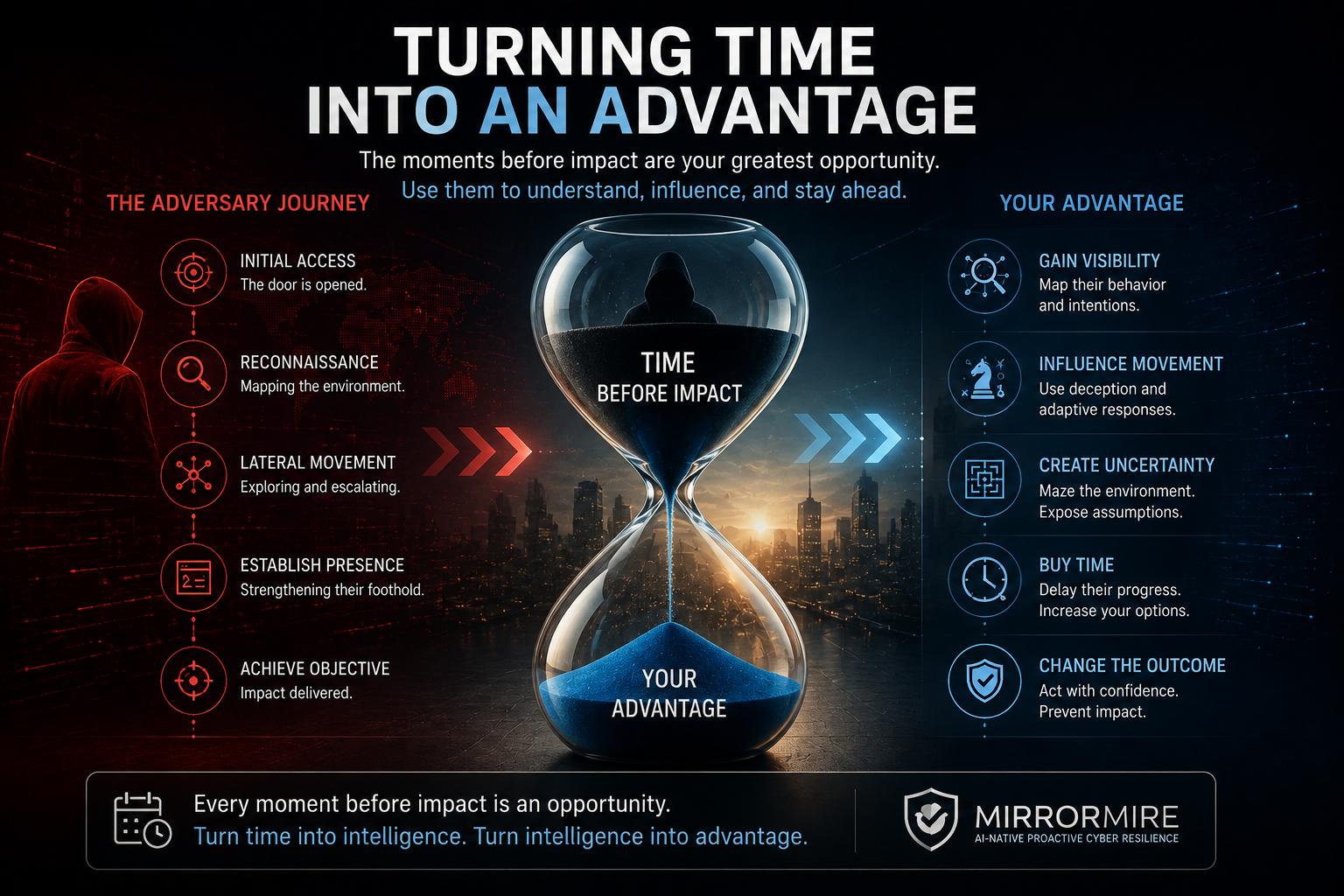
It will be defined by how effectively they can anticipate, engage, understand, and disrupt adversaries before they create impact.
Because an intrusion is only the beginning.
Don't wait for the impact. Use the window before it to change the game.
Learn more about MirrorMire and its approach to AI-native proactive cyber resilience.