
Why Attackers Hate Deception
Part of our guide to deception technology
Discover how AI-native deception helps expose adversary behavior, turn deceptive interactions into actionable intelligence, and strengthen proactive cyber resilience.
Attackers rely on uncertainty to stay hidden. Deception turns that uncertainty against them.
Modern attackers don't always rush to deploy malware or steal data. Often, they move quietly exploring systems, searching for credentials, identifying valuable assets, and looking for ways to move deeper into an environment without being detected.
Traditional security tools play a critical role in blocking malicious activity and identifying suspicious behavior. But what happens when an attacker gets past the initial defenses?
Defenders need more than an alert that something looks suspicious. They need to understand what the adversary is trying to do, where they are going, and what they intend to target.
That is where cybersecurity deception changes the equation.
From Blocking Activity to Understanding Behavior

Imagine an attacker gains access to an environment and begins searching for credentials that could help them reach other systems.
Among the assets they discover is a deliberately placed decoy credential, designed to look like a legitimate part of the environment.
The attacker attempts to use it.
Instead of simply observing another suspicious event, the security team now has a potentially high-confidence signal that someone may be exploring or attempting to compromise the environment.
Depending on the deception setup and the activity observed, the team may be able to investigate:
- What attracted the attacker: Which credentials, systems, or resources drew their attention?
- How they attempted to move: Did they try to access another system or escalate their access?
- What they may be pursuing: Were they looking for sensitive data, privileged access, or a path to critical infrastructure?
Each interaction can add context to the investigation, helping security teams build a clearer picture of adversary behavior.
The goal is not simply to detect activity. It is to understand the intent behind it.
From Alerts to Higher-Confidence Intelligence
Security operations teams face a persistent challenge: distinguishing meaningful threats from the enormous volume of activity generated across their environments.
Deception can help address this challenge.
Legitimate users generally have no reason to interact with carefully placed decoys. When an unknown actor attempts to use a deceptive credential or access a decoy system, that interaction can provide a stronger indicator of malicious intent than a generic anomaly alone.
This can help security teams prioritize investigations, reduce time spent triaging low-value alerts, and focus on activity that deserves immediate attention.
The distinction matters: a decoy interaction is not automatically proof of a successful breach, and its significance depends on how the decoy is deployed and monitored. But when designed and positioned effectively, deception can provide valuable, high-fidelity signals that complement existing security controls.
The advantage is not just knowing that something happened. It's gaining insight into what the adversary is doing.
How AI Changes the Deception Equation
As attackers increasingly use automation and AI-assisted techniques, defenders need deception environments that can keep pace with changing behavior.
Static decoys can be useful, but their effectiveness depends on how realistically they fit the environment and how well they support the detection objectives.
AI-native deception offers an opportunity to make these environments more dynamic and responsive.
At MirrorMire, our approach centers on AMaze™, an AI-native proactive cyber resilience platform built around the idea that understanding adversaries starts with creating environments in which their behavior becomes observable.
Two concepts are central to this approach:
Neural Echoes
Neural Echoes are part of MirrorMire's approach to creating a deceptive environment that can reflect relevant patterns of digital activity. Their role is to support a more convincing and informative deception experience. The specific behaviors and adaptation mechanisms depend on the platform's implementation.
Synthetic Cognitive Agents
Synthetic Cognitive Agents are AI-powered entities designed to emulate aspects of user behavior within a digital environment. By helping create more realistic patterns of activity, they support the broader goal of making deceptive assets more convincing to an adversary.

Why does this matter?
Automated attackers make decisions based on the information, credentials, and pathways they encounter. If deceptive assets appear credible, an attacker—or an automated tool acting on the attacker's behalf—may interact with them and reveal activity that defenders can observe.
AI does not make deception automatically effective. Realism, appropriate placement, monitoring, and sound security operations remain essential. But AI-native approaches create new possibilities for building deceptive environments that better reflect the complexity of modern digital systems.
Realism Matters: Deception Must Be Believable
Sophisticated attackers may look for signs that a system is a honeypot or decoy. Unconvincing assets, unusual configurations, or inconsistent behavior can reveal that something is not what it appears to be.
That is why deception cannot stop at placing a fake credential or isolated server into an environment.
Effective deception requires careful design: assets should fit their surroundings, interactions should make sense, and the resulting activity should provide useful information to defenders.
Deception also works best as part of a broader security strategy—not as a replacement for endpoint protection, identity security, network monitoring, or incident response.
Its value lies in adding another layer of visibility: one designed to encourage adversary interaction and make that interaction informative.
How MirrorMire Approaches Proactive Cyber Resilience
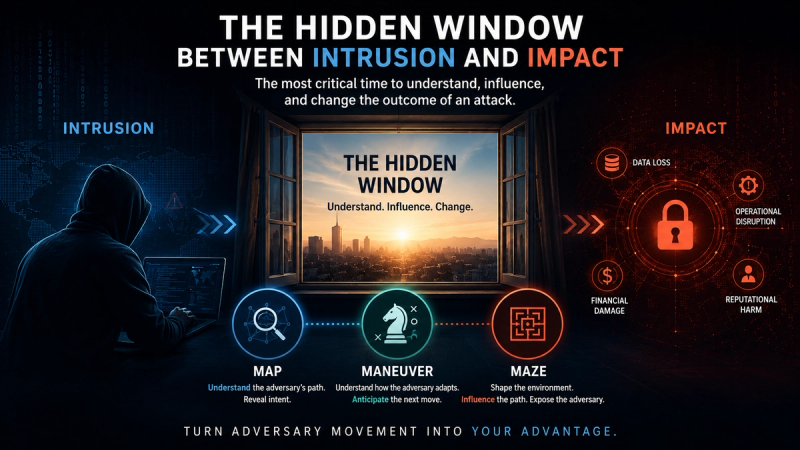
At MirrorMire, we believe cybersecurity should move beyond waiting for threats to appear. It should help organizations understand their environments, anticipate adversary behavior, and turn interactions into actionable intelligence.
Our philosophy is captured in three words:
MAP.
Understand the environment, identify the assets and identities an adversary might pursue, and determine where deception can provide meaningful visibility.
MANEUVER.
Use strategically designed deceptive assets and realistic digital activity to influence adversary behavior and reveal their actions.
AMaze™.
Turn observed adversary interactions into intelligence that helps defenders understand what was targeted, how an attacker behaved, and what to investigate next.
The objective is to help security teams move from reacting to individual alerts toward developing a more informed understanding of the adversary.
A More Proactive Approach to Cyber Resilience
The future of cybersecurity isn't only about building stronger walls.
It's about creating smarter environments—ones that can detect, adapt, misdirect, and learn from adversary behavior.
At MirrorMire, we believe cybersecurity should move beyond simply waiting for threats to appear.
The goal is to understand the adversary before the adversary understands you.
Contact us to learn more about MirrorMire's approach to proactive cyber resilience and AMaze™.