
The Attacker Only Has to Be Right Once. We Think That Rule Should Break.
Part of our guide to deception technology
A trip-wire answers one question: did you touch it? A reflection asks a harder one: can you tell you're not in the real plant? Now the attacker is the one who has to be right every time.
Security has lived under one unfair law for as long as it has existed: the defender has to be right every time, and the attacker only has to be right once. Every firewall, every patch, every segmented network is an attempt to hold a perfect line, and a perfect line is the one thing no real environment ever has. Credentials get stolen. Vendors get compromised. A misconfiguration opens a door nobody knew was there.
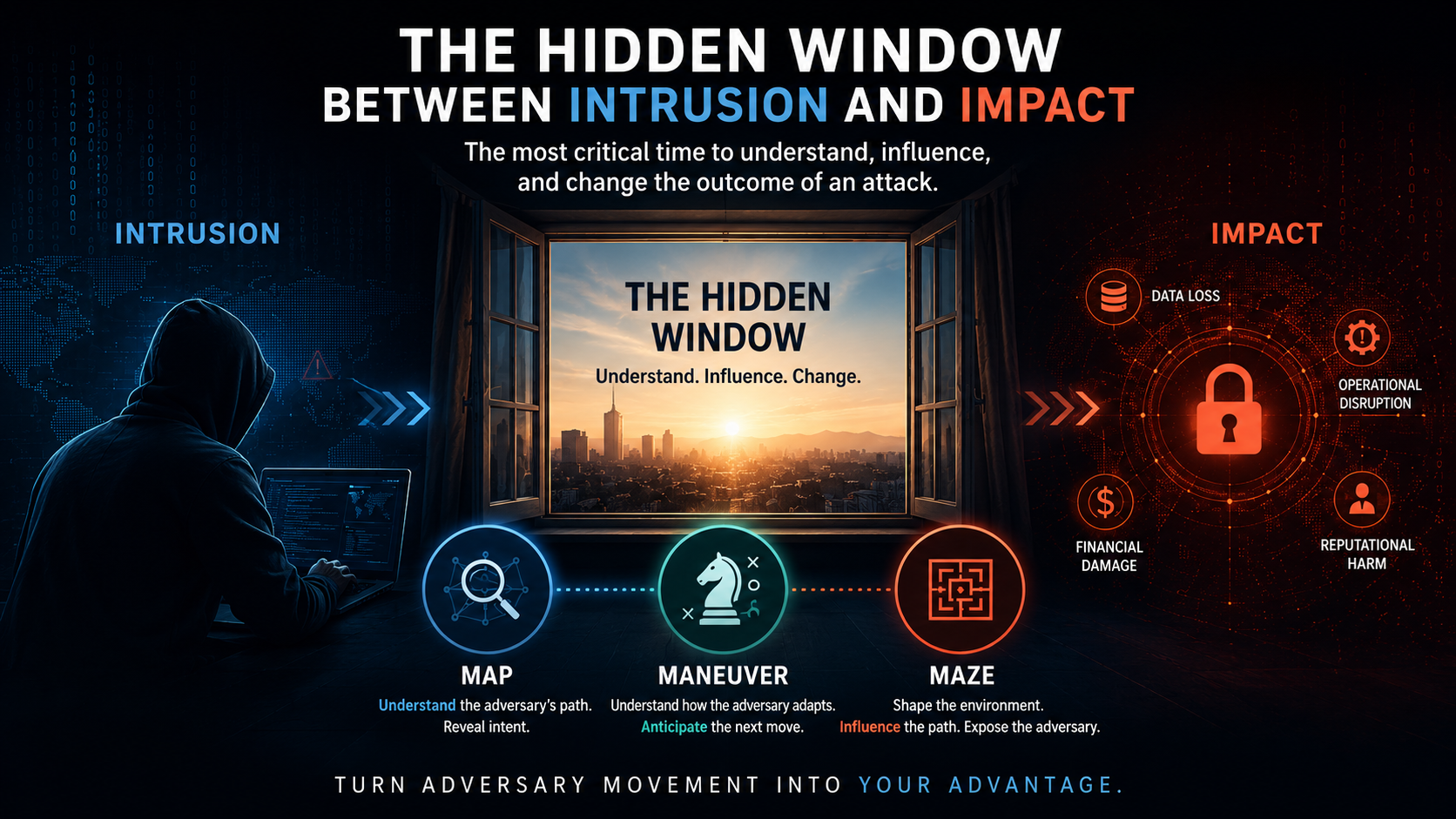
In operational technology, the systems that run factories, grids, pipelines, and water, that asymmetry carries more weight than anywhere else, because a breach can reach the physical process and not only the data around it. So the real question was never how to keep every attacker out forever, because no one can. The question is what happens in the hours and days after someone gets in, while they quietly learn your environment and decide how to hurt it.
That window is real, and it is long. In 2025, Dragos tracked 119 ransomware groups targeting industrial organizations, collectively affecting roughly 3,300 of them, with manufacturing making up more than two-thirds of the victims. Most of those intrusions did not begin with someone touching a controller. They began with someone touching the ordinary systems around it, an engineering workstation, a historian, a remote-access server, and looking around. The damage starts there, in the looking, long before anything visibly breaks.
So the goal is to catch the looking. The tools the industry built for that job have started to hit a ceiling.
Where today's defenses plateau
Traditional monitoring watches for anomalies: unusual connections, unfamiliar commands, new devices. It works, but it speaks in maybes. An odd connection might be an attacker, or an engineer doing maintenance. A new device might be a foothold, or a planned expansion. In an OT environment, where you cannot tear into the process to chase every hunch, a stream of maybes becomes its own kind of blindness, and teams learn to tune it out.
Decoys were the field's answer to the noise. Plant something fake that no legitimate user has any reason to touch, and an interaction with it turns a maybe into something close to certainty. That was a real improvement, which is why the approach has been around for decades.
The limit is that a basic decoy behaves like a trip-wire. It sits in the dark and waits, and the most it can ever report is that something stepped on it. It cannot hold an intruder's attention, study how they think, or react when they grow suspicious. A careful attacker who senses that a system is too quiet and too empty will leave, and leave knowing you are watching.
So you are left choosing between noise you cannot trust and a single bit of truth that goes silent the moment it fires. Neither one does the thing you actually need, which is to understand the adversary while they are still inside and still exposed.
A reflection that behaves
The step forward is a different kind of object. Instead of a single fake system, picture a convincing reflection of your operational world. HMIs that show physically plausible values and let them drift the way a real process drifts. Engineering systems that respond the way the real ones would. A world that reads as inhabited rather than abandoned, so an intruder who breaks in does not find an empty room with one suspicious chair in the middle of it. They find a plant that appears to be running, staffed, and real.
This is where the name comes from. MirrorMire holds two ideas together. The mirror is the synthetic reflection of your environment, close enough to the real thing that an attacker cannot tell which world they are standing in. The mire is what that reflection becomes once they commit to it: a place that draws them deeper, costs them time, and turns every move into intelligence, while the real process stays untouched and unaware.
AMazeTM builds that world out of two things. Neural Echoes are the lures and breadcrumbs scattered across the environment, the traces of credentials, systems, and paths that an attacker expects to find and follows toward what looks like the prize. Synthetic Cognitive Agents are where those breadcrumbs lead. They are high-interaction systems, real enough to work with, that occupy an intruder and keep them engaged long enough for reconnaissance, credential misuse, and lateral movement to become a recorded account of who they are and what they came to do.
The asymmetry switches sides
This is what changes the math. A trip-wire answers one question: did you touch it? A reflection that behaves asks a harder one: can you tell you are not in the real plant? Once that becomes the question facing an intruder, the oldest rule in security starts to bend.
Now the attacker is the one who has to be right every time. Every system they enumerate, every credential they try, every step sideways is a coin-flip on whether the thing in front of them is real or synthetic, and a single interaction with the synthetic side gives them away. The defender no longer needs a perfect line. The defender needs a convincing reflection, and lets the intruder's own thoroughness expose them. The more carefully they explore, the deeper into the mire they go. The asymmetry that has always favored the attacker quietly switches sides.
Built for the realities of OT
Engagement only earns its place in an industrial environment if it respects the constraints that make OT different.
- Separation from the process. The synthetic environment stays fully isolated from the physical plant, so it can reflect operations with no risk of disrupting them.
- Realism that holds up. A decoy that is obviously fake teaches you nothing. The value comes from systems credible enough that a skilled adversary commits to them.
- Placement along the real paths. The synthetic world belongs where attackers actually go after entry: remote-access zones, engineering networks, the IT/OT boundary, and the approaches to high-value systems.
- Intelligence over alarms. An engagement should report what the attacker touched, which identities and systems were involved, where it came from, and what it implies, then feed that into your existing SIEM, SOAR, and incident response rather than a dashboard nobody watches.
- Human judgment on response. In OT, automated containment can be as disruptive as the attack itself. Engagement buys back the one resource defenders never have enough of, time, so people can decide how to respond without putting operations at risk.
Detect when the looking begins
The most dangerous phase of an OT intrusion is the quiet one. The intruder is already inside, mapping the environment and choosing a target, and nothing has visibly broken yet. Most approaches treat that window as something to survive. We treat it as the opening. Give an attacker a world that reflects yours closely enough, and the reconnaissance that used to be invisible becomes the moment they reveal themselves.
In operational technology, the right time to catch an intruder is the moment they start looking for a way to stop production, when the first thing they reach for turns out to be a reflection.