
Beyond Reactive Security: Using Neural Echoes and Synthetic Cognitive Agents for Early Threat Detection
Part of our guide to deception technology
Move beyond reactive security. Explore how Neural Echoes and Synthetic Cognitive Agents enable proactive threat detection, reduce alert fatigue, and strengthen cyber resilience.
Introduction: Why Traditional Security Often Reacts Too Late
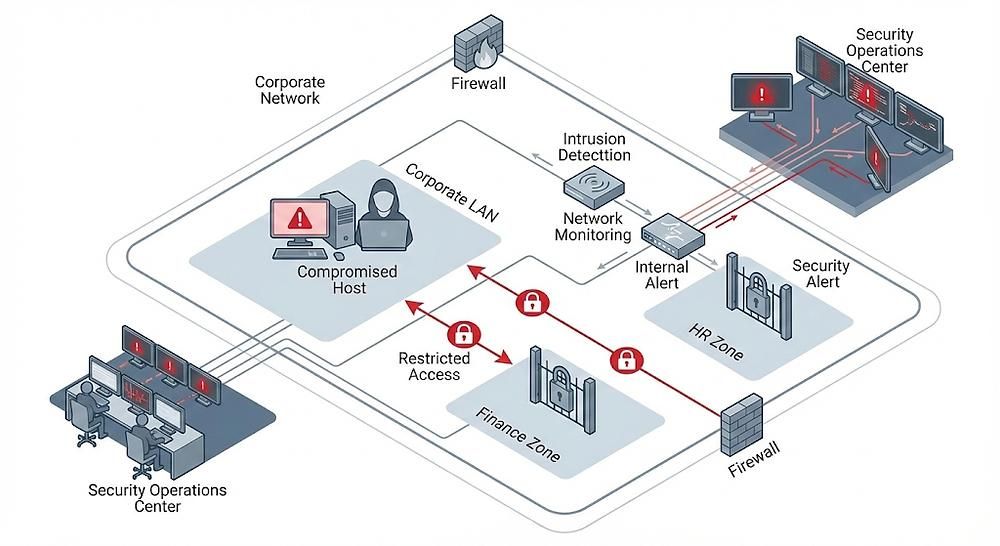
Most cybersecurity tools are designed to identify threats after suspicious activity has already occurred. Alerts are triggered when malware executes, credentials are compromised, or attackers begin moving through the environment. By then, defenders are already responding to an active incident.
Organizations need a way to detect attackers earlier - before they reach critical systems, sensitive data, or operational technology. This is where Neural Echoes and Synthetic Cognitive Agents introduce a new approach to cyber defense.
The Problem with Reactive Security
Traditional security controls rely heavily on indicators of compromise, signatures, behavioral anomalies, and known attack patterns.
While these approaches remain important, sophisticated adversaries increasingly avoid triggering conventional alerts by:
- Using legitimate credentials
- Moving slowly through environments
- Exploiting trusted tools and processes
- Blending into normal user activity
As a result, organizations may not discover an intrusion until significant damage has already occurred.
What Are Neural Echoes?
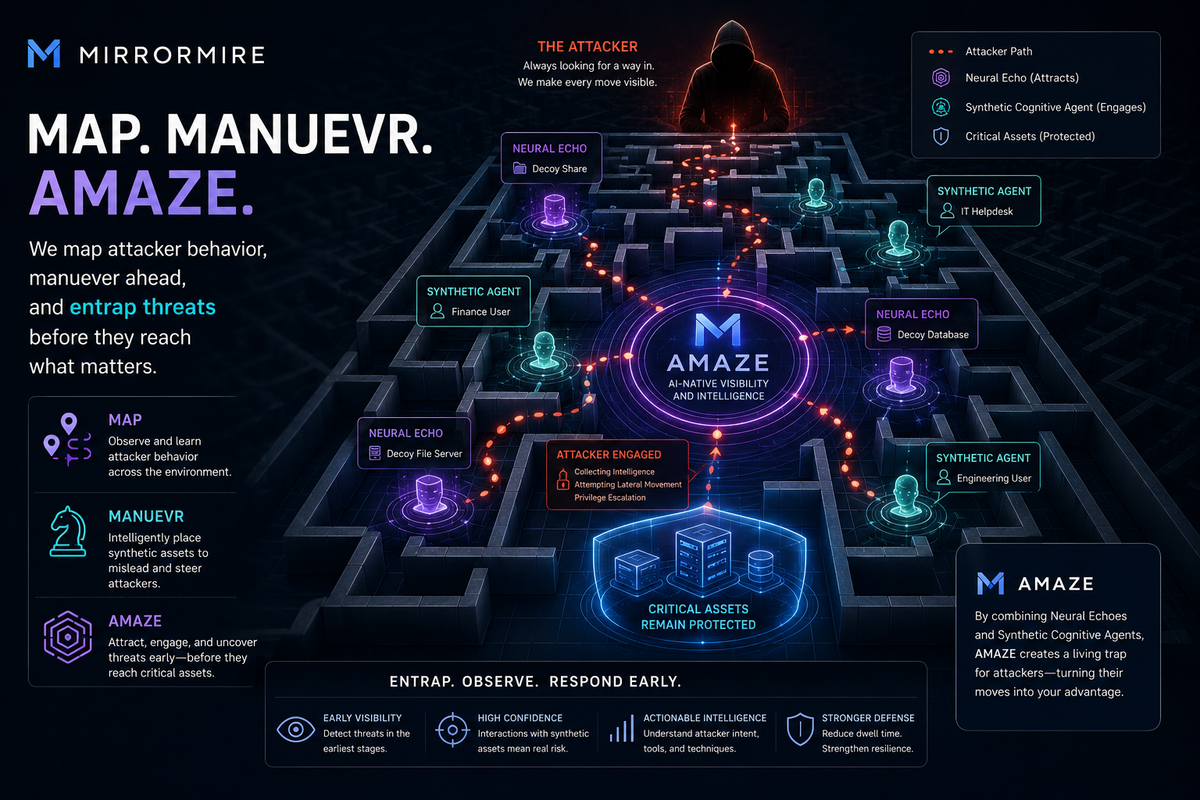
Neural Echoes are intelligent digital artifacts designed to attract, observe, and capture attacker interactions before they impact real assets.
Unlike traditional decoys that simply imitate assets, Neural Echoes create realistic interactions that generate insights into how adversaries think, probe, and move through an environment.
These interactions provide valuable intelligence long before production systems are touched.
Benefits of Neural Echoes
- Reveal attacker reconnaissance activities
- Expose lateral movement attempts
- Generate high-confidence alerts
- Reduce false positives
- Improve visibility into emerging attack techniques
Introducing Synthetic Cognitive Agents
Synthetic Cognitive Agents are AI-powered entities that emulate authentic user behavior, system activity, and business interactions across an environment.
They are designed to appear authentic to attackers while remaining isolated from production operations.
These agents can:
- Generate authentic user activity
- Engage with enterprise applications and files
- Generate believable digital footprints
- Respond dynamically to attacker actions
For threat actors, distinguishing between a real asset and a Synthetic Cognitive Agent becomes increasingly difficult.
How Early Threat Detection Changes the Game
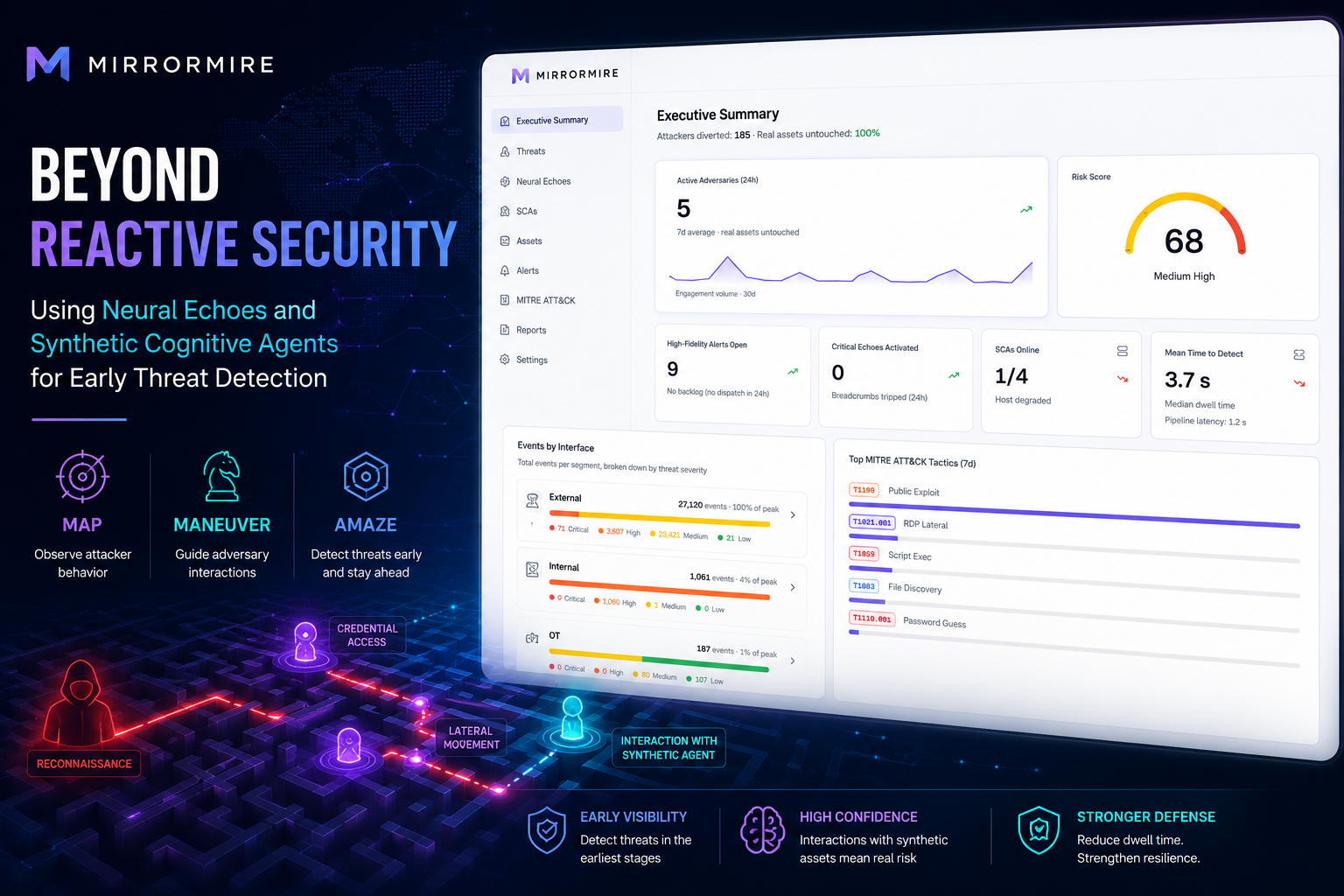
When attackers encounter Neural Echoes or Synthetic Cognitive Agents, every interaction becomes high fidelity alert and an opportunity for defenders.
Instead of waiting for malicious activity to impact production systems, security teams gain visibility into:
- Initial reconnaissance
- Credential harvesting attempts
- Privilege escalation efforts
- Internal discovery activities
- Lateral movement techniques
This shifts security from incident response to threat anticipation.
Reducing Alert Fatigue with High-Confidence Signals
Security teams often struggle with overwhelming alert volumes.
Many alerts represent benign activity, forcing analysts to spend valuable time investigating events that pose little risk.
Interactions with Synthetic Cognitive Agents are fundamentally different.
Legitimate users have no reason to access these assets. As a result, engagements often represent highly suspicious activity, providing security teams with stronger signals and faster triage.
Strengthening Cyber Resilience With AMazeTM
Modern cyber resilience requires more than prevention.
Organizations must assume that attackers will eventually gain some level of access and focus on detecting them quickly.
Neural Echoes and Synthetic Cognitive Agents create a proactive detection layer that:
- Extends visibility across environments
- Accelerates threat discovery
- Increases attacker uncertainty
- Improves incident response effectiveness
- Reduces attacker dwell time
The result is a stronger, more resilient security posture.
The Future of Cyber Defense
As AI transforms both attack and defense strategies, organizations need security approaches that evolve at the same pace.
Neural Echoes and Synthetic Cognitive Agents represent a shift from static defenses to intelligent, adaptive detection capabilities.
Rather than waiting for evidence of compromise, defenders can create environments that actively expose adversary behavior, providing earlier warning, better intelligence, and faster response.
Conclusion
Cybersecurity can no longer rely solely on detecting attacks after damage begins. By leveraging Neural Echoes and Synthetic Cognitive Agents, organizations gain the ability to identify adversaries during the earliest stages of an intrusion.
Early visibility creates decisive advantages. The sooner defenders understand attacker intent and behavior, the greater their ability to protect critical systems, data, and operations.