
The CISO Response to Mythos: Build a Deception Capability
Part of our guide to deception technology
A new industry briefing warns that AI is compressing the path from vulnerability discovery to exploitation and identifies deception as an important control for detecting attacks that patching alone cannot stop.
Anthropic’s Claude Mythos has quickly become one of the clearest examples of how artificial intelligence may reshape offensive cybersecurity.
Its significance is not limited to the vulnerabilities it can discover. Mythos demonstrates how AI can reduce the time, cost, and specialized expertise required to analyze software, identify weaknesses, develop exploits, and construct increasingly complex attack paths.
For security leaders, that creates a difficult imbalance.
AI can help defenders review code and develop patches faster. But organizations must still validate updates, test compatibility, schedule maintenance, coordinate with vendors, and protect systems that cannot be taken offline immediately.
Attackers do not operate under the same constraints.
This is why the conversation surrounding Mythos is beginning to move beyond vulnerability management. The question is no longer simply how quickly an organization can patch. It is also how that organization detects, contains, and understands an attacker when prevention is not fast enough.
A recent industry strategy briefing developed through the Cloud Security Alliance CISO Community, SANS, the OWASP Gen AI Security Project, and the wider security community offers a notable answer:
Build a deception capability.
Mythos Changes the Economics of Vulnerability Discovery
Security teams have always faced an asymmetric challenge.
Defenders must identify and protect every meaningful entry point. An attacker needs only one viable path.
AI makes this imbalance more difficult by automating work that previously required experienced vulnerability researchers, exploit developers, and operators. Models can inspect large codebases, investigate suspicious behavior, validate potential weaknesses, and assist with exploit development at a scale that human teams cannot easily match.
Mythos represents a visible step in that progression, but it should not be viewed as the endpoint.
Comparable capabilities will likely appear across additional commercial and open models. As they spread, organizations should expect a higher volume of vulnerability discoveries, faster exploit development, and more capable adversaries operating with AI assistance.
The defensive opportunity is significant. Security teams can use similar systems to inspect their own software, accelerate testing, and identify weaknesses before attackers do.
But the benefit will not be distributed evenly.
Large software vendors may be able to scan code and develop fixes quickly. Smaller maintainers, critical infrastructure operators, and organizations dependent on legacy technology may still struggle to convert a finding into a safely deployed patch.
That leaves a dangerous period between discovery and remediation.

Why Patching Alone Cannot Make an Organization Mythos-Ready
Patching remains one of the most important security practices an organization can perform. Nothing about Mythos changes that.
Organizations should strengthen asset inventory, vulnerability prioritization, software dependency management, secure development, segmentation, identity protection, and patch deployment.
But even highly mature organizations cannot guarantee that every vulnerability will be corrected before someone attempts to exploit it.
A patch may not yet exist. A third-party vendor may control the update. A production environment may require extensive testing. An industrial system may have only a few maintenance windows each year. A legacy asset may no longer be supported at all.
The problem becomes more severe in operational technology and critical infrastructure.
Taking a conventional application offline may cause inconvenience. Restarting a controller, disrupting a manufacturing line, or interrupting an energy or healthcare environment may create operational and safety consequences.
Security leaders must therefore prepare for two realities at the same time:
- Vulnerabilities should be remediated as quickly as possible.
- Some vulnerabilities will remain exposed long enough to be targeted.
A Mythos-ready program must address both.
That means investing not only in preventing entry, but also in identifying hostile behavior before it reaches critical systems.
The CISO Community Is Looking Beyond Prevention
The Cloud Security Alliance briefing, The “AI Vulnerability Storm”: Building a “Mythos-ready” Security Program, was developed as an expedited strategy guide for security leaders. Its authors, contributors, and reviewers include a broad group of CISOs, security practitioners, researchers, and former government cyber leaders.
The briefing does not suggest that organizations abandon their existing security controls. Its recommendations reinforce fundamentals such as:
- Segmentation and Zero Trust architecture
- Identity and access management
- Egress filtering
- Software and dependency inventories
- Faster vulnerability remediation
- AI-assisted security operations
- Automated containment and response
- Stronger coordination across vendors and industry groups
The report also recommends building a deception capability. This recommendation is important because deception does not depend on prior knowledge of the exact vulnerability, malware family, exploit technique, or AI model being used.
Rather than attempting to recognize only known malicious code, deception can reveal attackers through their behavior inside the environment. An attacker may use a new exploit, but they still need to discover systems, test access, use credentials, move between assets, and identify what appears valuable.
Deceptive assets create controlled opportunities throughout that process for the attacker to expose themselves.

Why Deception Fits the Mythos Threat Model
Traditional security tools often attempt to distinguish malicious behavior from legitimate activity across real production systems. This becomes difficult when attackers use valid credentials, trusted remote-access software, legitimate administrative tools, and authorized network protocols.
Deceptive assets operate under a different assumption. Legitimate employees, applications, and operational processes generally have no reason to access a decoy credential, synthetic server, deceptive file share, or simulated industrial asset. Interaction with one of these assets can therefore provide much stronger context than an isolated anomaly inside a production environment.
A well-designed deception capability can help security teams:
- Detect internal reconnaissance and unauthorized enumeration
- Identify stolen or misused credentials
- Expose lateral movement between systems
- Generate high-confidence alerts with less background noise
- Redirect hostile activity away from production assets
- Capture attacker commands, tools, payloads, and techniques
- Reconstruct the sequence of an attack
- Trigger containment through existing security workflows
This makes deception largely independent of the attacker’s initial point of entry. The compromise could begin with an AI-discovered zero-day, a stolen password, an exposed remote-access service, a supply-chain incident, or a malicious insider. Once the attacker begins exploring and moving through the environment, deception creates opportunities to detect and study that behavior.
This is especially useful when defenders have little prior intelligence about the vulnerability or exploit being used.
Deception Can Increase the Cost of AI-Assisted Attacks
One of the main concerns surrounding Mythos-class capabilities is scale. An AI-assisted attacker may be able to investigate more targets, test more pathways, and adapt more quickly than a human operator working alone.
However, automated attacks still depend on environmental feedback. An attacking system must determine:
- Which identities are valid
- Which systems are reachable
- Which services appear authentic
- Which assets contain valuable information
- Which pathways lead toward the intended objective
- Whether its activity has been detected
Deception can manipulate that feedback. Synthetic credentials can lead toward monitored resources. Decoy systems can appear to contain valuable information. Simulated services can respond convincingly to reconnaissance. Believable IT and OT assets can make it difficult for an attacker to determine which parts of the environment are genuine.
This does not merely create another alert. It changes the attacker’s decision-making environment. The adversary must spend additional time evaluating systems that may be deceptive, while the defender gains information about the attacker’s methods and objectives.
As AI lowers the cost of launching and scaling attacks, deception can help increase the cost of successfully navigating the target environment.

From Basic Canaries to Enterprise Deception
The CSA briefing identifies canaries and honey tokens as practical ways to begin building a deception capability. These controls can provide useful warning when a specific credential, file, URL, or resource is accessed.
Enterprise deception can extend beyond isolated tokens. It can create a connected defensive environment made up of believable systems, identities, services, data, and network pathways. Instead of waiting for a single decoy to be triggered, defenders can observe how an attacker discovers, evaluates, and moves through the environment.
This broader approach is increasingly important against AI-assisted threats. A capable adversarial agent may inspect several characteristics before deciding whether an asset is authentic. Static or isolated decoys may be easier to classify if they lack realistic behavior, network context, relationships, or activity.
A mature deception capability should therefore be:
- Believable enough to sustain attacker interaction
- Distributed across several parts of the environment
- Consistent with surrounding systems and network behavior
- Capable of representing both IT and OT assets
- Integrated with existing monitoring and response tools
- Adaptable as attacker techniques evolve
This moves deception beyond the idea of individual traps. It becomes an active resilience layer that helps the organization detect compromise, understand attacker behavior, and protect critical systems.
How MirrorMire AMazeTM Supports a Mythos-Ready Security Program
MirrorMire AMazeTM is an AI-native proactive cyber-resilience platform rooted in advanced deception. It places believable synthetic assets across IT and OT environments, creating controlled opportunities to detect reconnaissance, credential misuse, lateral movement, and attempted exploitation.
Synthetic Cognitive Agents can represent specialized systems and services, while Neural Echoes extend deceptive signals and pathways throughout the environment. When an adversary interacts with these assets, AMazeTM is designed to capture the surrounding behavior and connect individual events into a broader attack narrative.
This supports several outcomes emphasized in a Mythos-ready security strategy:
- Increasing attacker uncertainty and operational cost
- Detecting compromise earlier in the attack lifecycle
- Reducing pathways toward critical production assets
- Improving understanding of the attacker’s objectives
- Supporting faster investigation and containment
- Strengthening existing SIEM, SOAR, and SOC workflows
- Extending deception across both IT and OT environments
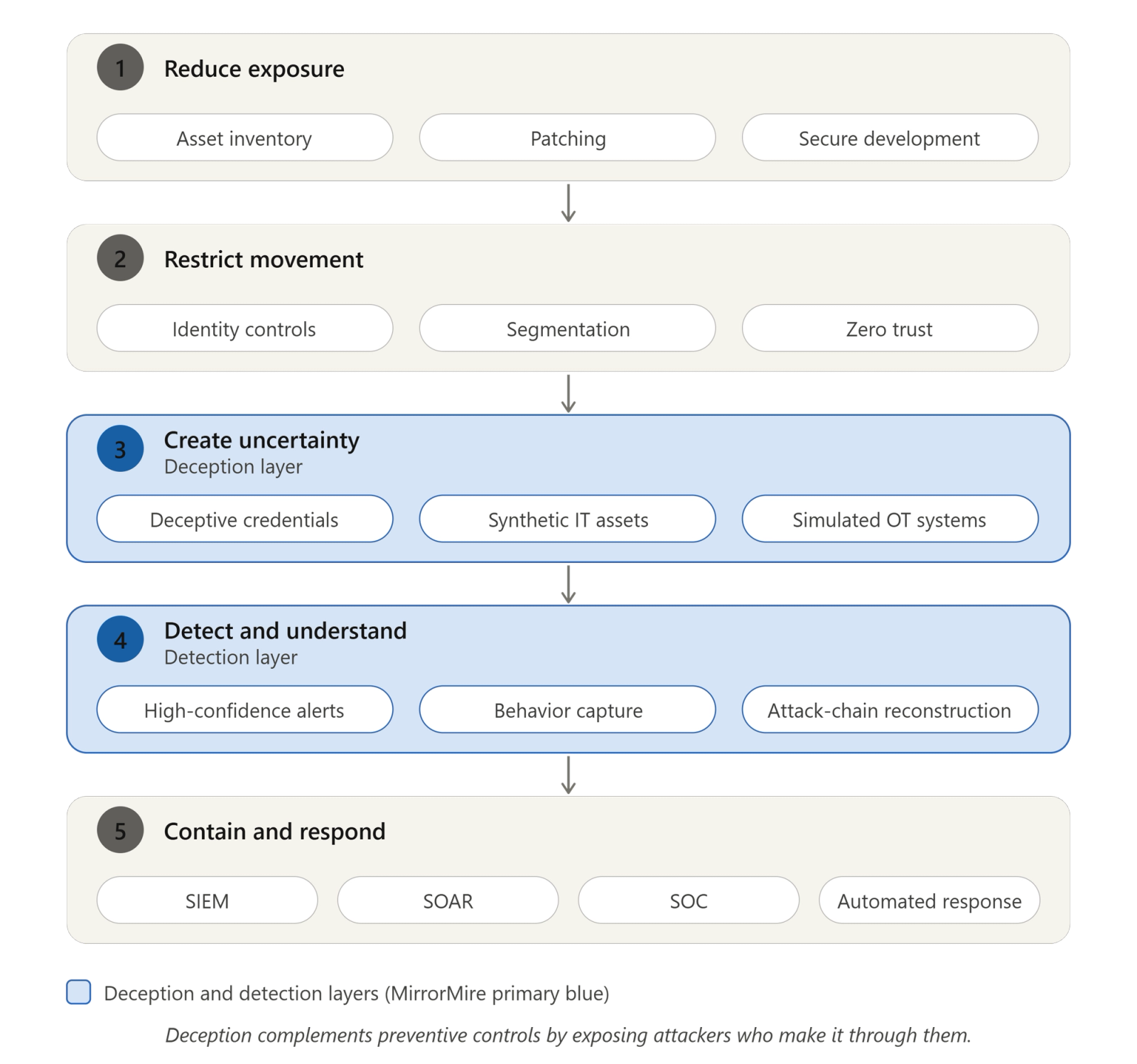
AMazeTM is not intended to replace vulnerability management, patching, segmentation, endpoint security, or identity controls. It adds a complementary layer designed to make hostile behavior more visible when preventive controls do not stop the initial compromise.
When security teams cannot know every vulnerability in advance, they need a way to identify what the attacker does next.
What CISOs Can Do Now
Security leaders do not need to rebuild their entire security architecture at once. A practical starting point is to identify where deception could create the greatest defensive value.
- Protect pathways toward critical assets. Place deceptive identities, systems, and services near assets that would be valuable to an attacker.
- Cover difficult-to-patch environments. Improve visibility around legacy, operational, and high-availability systems where remediation may be delayed.
- Detect credential misuse. Introduce deceptive credentials and identity pathways that legitimate users should never need to access.
- Integrate with current operations. Route alerts and captured behavior into the SIEM, SOAR, and incident-response workflows already used by the security team.
- Test against realistic attacker behavior. Evaluate whether deceptive assets remain believable during scanning, enumeration, authentication, and lateral movement.
- Pre-authorize appropriate response. Define which containment actions can occur automatically when a high-confidence deceptive asset is accessed.
These steps allow organizations to introduce deception gradually while ensuring it supports the wider security program rather than operating as an isolated technology
Mythos Is the Signal, Not the Whole Story
The lasting importance of Mythos is not tied to one model, benchmark, or product release. It reflects a broader direction in which AI continues to reduce the cost of vulnerability research, exploit development, reconnaissance, and attack orchestration.
Defensive teams will gain many of the same capabilities, but they will continue operating under business, staffing, regulatory, and operational constraints that attackers do not share. Organizations cannot assume that every weakness will be identified and fixed before exploitation begins.
A Mythos-ready security program must therefore combine prevention with resilience. It should reduce avoidable exposure, restrict attacker movement, generate high-confidence evidence of compromise, and support rapid containment when an attacker enters the environment.
The growing emphasis on deception within the security community reflects this requirement. When a vulnerability is unknown, an exploit is new, and the attacker is moving with AI assistance, defenders can still control the environment the adversary is attempting to navigate.
That control can be used to create uncertainty for the attacker and visibility for the defender.
Build Deception Into Your Mythos-Ready Strategy
Explore how MirrorMire AMazeTM uses AI-native deception to expose reconnaissance, credential misuse, lateral movement, and attacks across IT and OT environments.